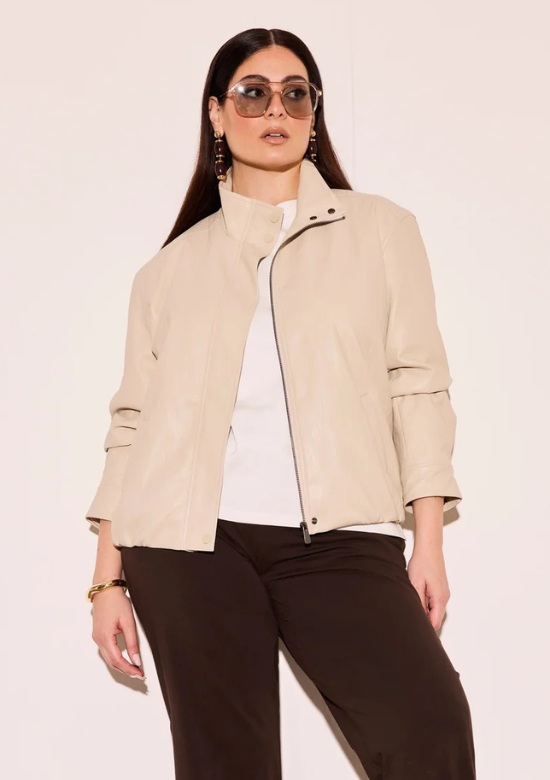
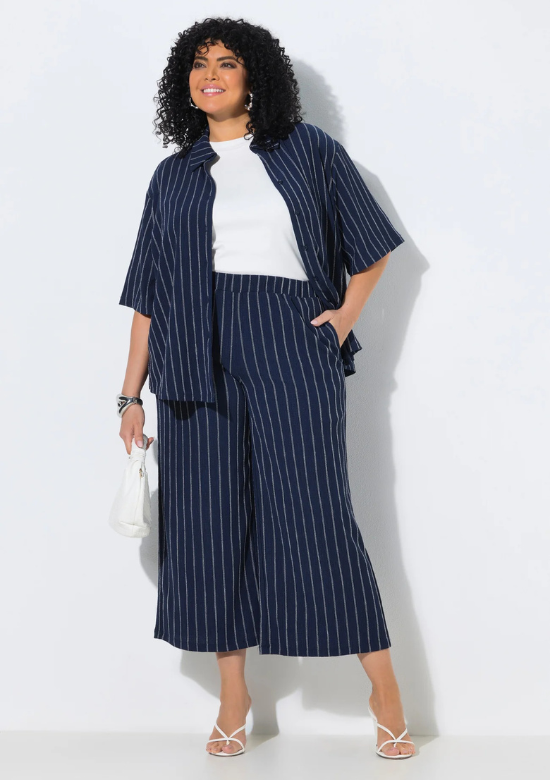
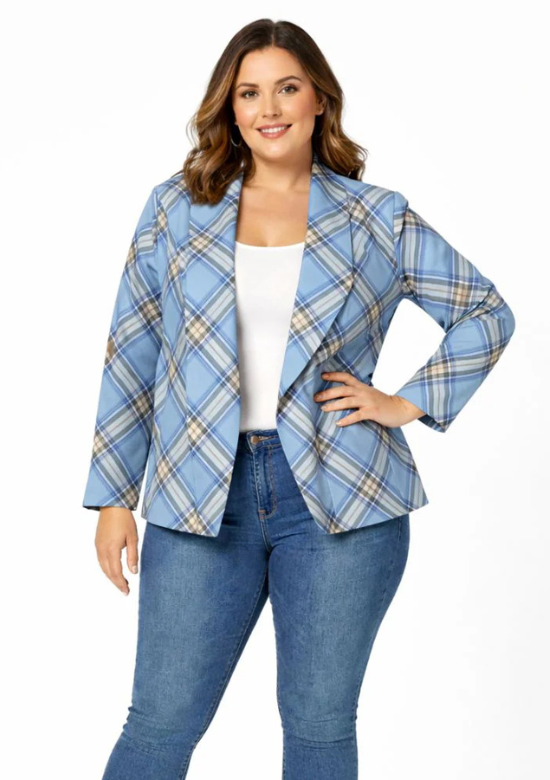

Ulla Popken sizes its clothing on one consistent scale from size 42 to size 68, with measurements based on a height of 167–174 cm. The same scale is also shown adjusted for shorter and taller heights — this is why you may see jeans labelled with numbers like 21 or 22 rather than 42 or 44: it's the same size, shown in the shorter-height version (see below).
Tops vs bottoms – which sizing applies?
Based on our own range, the two categories follow a clear and useful pattern:
- Tops almost always use double sizing (42/44, 46/48, 50/52...). Nearly every blouse, t-shirt, tunic, cardigan and top we stock is cut this way — a single design built to fit comfortably across two consecutive sizes.
- Bottoms are split: relaxed-fit styles — wide-leg trousers, culottes, skirts, leggings — mostly use double sizing too. But fitted styles run single sizes instead: 7/8th trousers, slim/straight trousers in solid colours, and jeggings are sized 42, 44, 46... one size per fit, not a range. The tighter the cut, the less room there is for one garment to comfortably span two sizes, so Ulla Popken sizes these more precisely.
- Jeans show a different-looking number (21, 22, 23...) but this is the same 42–68 scale — just shown in the shorter-height version, where the number is exactly half the regular-height size (e.g. jeans size 21 = clothing size 42). See the height variants section below.
In practice: if you're shopping for a blouse or a wide-leg trouser, look for a double size. If you're shopping for slim 7/8th trousers or jeggings, you'll see single sizes only. If you're shopping for jeans and the size looks unusually low (in the 20s), check whether it's labelled for a shorter height — it's the same size range as everything else, just relabelled.
How to measure yourself
- Chest: measured horizontally at the fullest part of the chest.
- Waist: measured horizontally at the narrowest part of the waist.
- Hip: measured horizontally at the widest part of the buttocks.
- Waist height (trousers only): the difference between the side length and the inside leg length, showing where the waistband sits. The higher the waist height, the higher the trousers sit.
Tops & upper body – size chart (cm)
| Size | Chest (cm) | Waist (cm) | Hip (cm) |
|---|---|---|---|
| 42 | 99–102 | 82–85 | 105–108 |
| 44 | 103–106 | 86–89 | 109–112 |
| 46 | 107–110 | 90–93 | 113–116 |
| 48 | 111–116 | 94–99 | 117–122 |
| 50 | 117–122 | 100–105 | 123–128 |
| 52 | 123–128 | 106–111 | 129–134 |
| 54 | 129–134 | 112–118 | 135–140 |
| 56 | 135–140 | 119–125 | 141–146 |
| 58 | 141–146 | 126–132 | 147–152 |
| 60 | 147–152 | 133–139 | 153–158 |
| 62 | 153–158 | 140–146 | 159–164 |
| 64 | 159–164 | 147–153 | 165–170 |
| 66 | 165–170 | 154–160 | 171–176 |
| 68 | 171–176 | 161–167 | 177–182 |
Bottoms & lower body – size chart (cm)
| Size | Waist (cm) | Hip (cm) |
|---|---|---|
| 42 | 82–85 | 105–108 |
| 44 | 86–89 | 109–112 |
| 46 | 90–93 | 113–116 |
| 48 | 94–99 | 117–122 |
| 50 | 100–105 | 123–128 |
| 52 | 106–111 | 129–134 |
| 54 | 112–118 | 135–140 |
| 56 | 119–125 | 141–146 |
| 58 | 126–132 | 147–152 |
| 60 | 133–139 | 153–158 |
| 62 | 140–146 | 159–164 |
| 64 | 147–153 | 165–170 |
| 66 | 154–160 | 171–176 |
| 68 | 161–167 | 177–182 |
Source: Ulla Popken official size chart. Waist and hip measurements are the same across tops and bottoms; chest measurement applies to tops only.
Height variants (regular, shorter, taller)
Ulla Popken's size chart accounts for height as well as body measurements. The size numbers above assume a height of 167–174cm (labelled "N" for regular/normal). The same sizes are also available in versions for different heights:
| Regular height (167–174cm) | Shorter (under 167cm) | Taller (over 174cm) |
|---|---|---|
| 42 | 21 | 84 |
| 44 | 22 | 88 |
| 46 | 23 | 92 |
| 48 | 24 | 96 |
| 50 | 25 | 100 |
| 52 | 26 | 104 |
| 54 | 27 | 108 |
| 56 | 28 | 112 |
| 58 | 29 | 116 |
| 60 | 30 | 120 |
| 62 | 31 | 124 |
| 64 | 32 | 128 |
| 66 | 33 | 132 |
| 68 | 34 | 136 |
This is the same body measurements throughout each row — only the labelling changes by height. This is why jeans are often labelled 21, 22, 23...: that's simply the shorter-height version of sizes 42, 44, 46. If you're around average height (167–174cm), ignore the shorter/taller columns and use the regular size number from the charts above.
UK size equivalent
| Ulla Popken Size | Fits UK Size |
|---|---|
| 42 | 16 |
| 44 | 18 |
| 46 | 20 |
| 48 | 22 |
| 50 | 24 |
| 52 | 26 |
| 54 | 28 |
| 56 | 30 |
| 58 | 32 |
| 60 | 34 |
| 62 | 36 |
| 64 | 38 |
| 66 | 40 |
| 68 | 42 |
Frequently asked questions
Why is my jeans size a much lower number than my usual size?
Jeans (and some trousers) are often labelled using the shorter-height version of the size scale, where the number is exactly half the regular size. A jeans size 21 is the same body size as clothing size 42 — it isn't a different, smaller size, just a different label for the same fit at a shorter height.
Do tops and bottoms use the same sizing?
The underlying body measurements are the same scale, but how it's presented differs. Tops are almost always double-sized (e.g. 42/44). Bottoms vary: relaxed styles like wide-leg trousers, culottes and skirts are usually double-sized too, but fitted styles — 7/8th trousers, slim trousers and jeggings — are sized individually (42, 44, 46...), and jeans may show the shorter-height number instead. Check the size options on the specific product.
I usually wear a UK 16 – what size is that at Ulla Popken?
That's Ulla Popken size 42 (or 42/44 for double-sized tops). If you're shopping for jeans labelled in the shorter-height format, that's size 21. If you're noticeably taller than 174cm, look for the corresponding taller-height number instead (84, in this case).
Does Ulla Popken run true to size?
Fit can vary by style and fabric — some elastic-waist and knit styles run more generously than structured, woven pieces. If you're between two sizes, it's often safer to size up, particularly in fitted or non-stretch styles.
What is "waist height" on Ulla Popken trousers?
It's how high the waistband sits, measured as the difference between the side seam length and the inside leg length. A higher waist height means the trousers sit higher on the waist; a lower one means a lower-rise fit. This is different from the height-variant sizing (regular/shorter/taller) described above, which is about the wearer's height, not the trouser rise.
Last updated: 15/07/2027